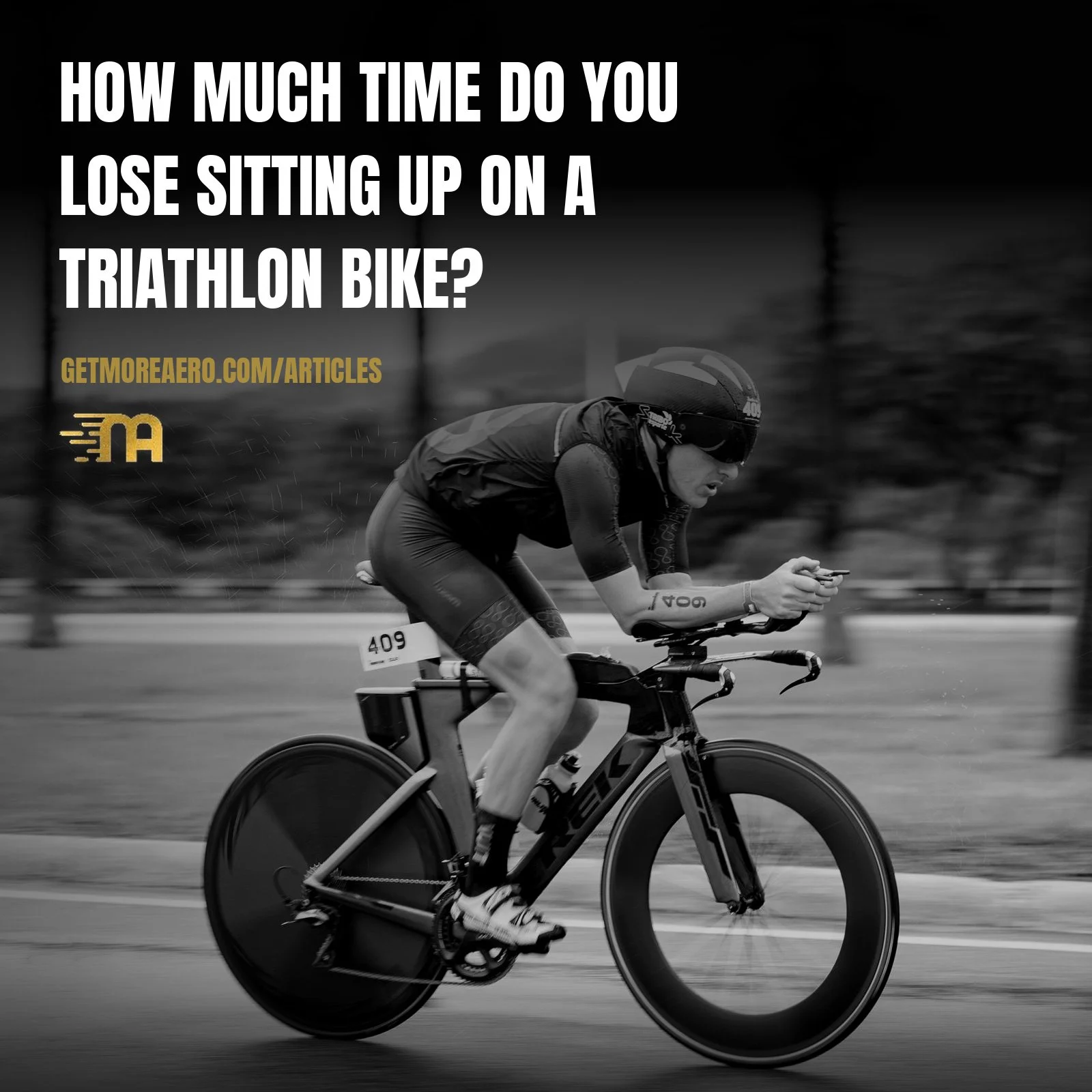
How Much Time Do You Lose Sitting Up On Your Tri Bike?
You have trained for months, dialled in your target power and invested in an aero setup. Then, during the race, you sit up to drink. A few minutes later, you sit up to stretch. By the final hour, you are spending more time on the base bar than you expected.
Your power meter might still show the right number. Your speed tells a different story.
For triathletes, a useful question is: how much of the race can you actually spend in your aero position?
What happens when you sit up?
Moving from the extensions to a more upright position changes the shape you present to the wind. If that increases aerodynamic drag, maintaining the same power means travelling more slowly. Maintaining the same speed requires more power.
Engineers describe aerodynamic drag using CdA, a measure that combines your frontal area and how easily air flows around you and the bike. A lower number means less drag under the same conditions.
There is no universal penalty for sitting up. It depends on how different the two positions are, your speed, wind and terrain. But a worked example shows why the habit is worth examining.
A 90 km example: same rider, same watts
Imagine a triathlete riding a flat, windless 90 km course at a constant 220 watts.
For this example, we assume a CdA of 0.25 m² in the aero position and 0.35 m² sitting upright. These are illustrative inputs, not measurements of a particular athlete.
Under the model, the rider travels at approximately 37.9 km/h in aero and 34.1 km/h upright.
|Time spent upright|Example pattern |Estimated 90 km time|Time added |
|------------------|------------------------------------|--------------------|--------------------|
|0% |Entirely aero, theoretical reference|2:22:18 |Reference |
|5% |15 seconds of every five minutes |2:23:01 |43 seconds |
|10% |30 seconds of every five minutes |2:23:45 |1 minute 26 seconds |
|20% |One minute of every five minutes |2:25:13 |2 minutes 55 seconds|
The point is not that every triathlete will lose exactly these amounts. It is that repeated short periods upright can accumulate into a meaningful difference, even when your power stays consistent.
Model assumptions: 85 kg combined rider and bike mass; rolling resistance coefficient 0.004; air density 1.225 kg/m³; 97.5% drivetrain efficiency; constant crank power. Times use steady state speeds weighted by the proportion of riding time in each position. The model excludes acceleration and deceleration, hills, wind, braking and traffic. It is an illustration, not a race prediction.
Why not just push harder?
In this same example, maintaining the speed in the aero position while upright would require approximately 294 watts instead of 220 watts.
That is a substantial increase simply to hold the same speed. Repeatedly chasing speed by lifting your power also changes the effort you planned for the bike leg.
In triathlon, you still have a run to complete. Your bike plan needs to make sense within the whole race.
The lowest position is not automatically your best position
A position can look fast in a photograph and become difficult to sustain after an hour.
Research on time trial positioning has examined the balance between aerodynamic drag, power production and physiological demands. Lowering the torso can reduce drag, but it can also affect the power a rider can produce.[1,2]
For a triathlete, that makes sustainability part of the equipment decision. Arm support, pad width, reach, extension angle and saddle setup all deserve attention.
A slightly higher position that you can maintain may produce a better result than a lower one that repeatedly sends you back to the base bar. That is something to test, rather than assume from appearance.
Make drinking and eating part of the setup
Look at what actually makes you leave the extensions.
Can you reach your drink comfortably? Can you access your nutrition without a prolonged search? Can you see your bike computer without repeatedly lifting your whole upper body?
A well positioned hydration system may help you drink with less disruption, but its practical value depends on your individual setup. Practise with your race bottles, nutrition and clothing before race day.
Never skip drinking or eating to protect an aero position. The aim is to make your fuelling plan easier to execute.
When should you move to the base bar on a climb?
A climb does not automatically mean you should sit up. As speed falls, the aerodynamic cost of moving to the base bar becomes smaller, so comfort, control and your ability to pedal effectively become more important.
As a practical starting point in calm conditions, rather than a fixed cutoff:
Above 25 km/h: staying aero is usually worth prioritising if you can maintain your planned power comfortably and safely.
Between 20 and 25 km/h: weigh the aero benefit against how you feel. Moving to the base bar can make sense if it helps you pedal more comfortably or gives you a useful position break.
Below 20 km/h: moving to the base bar is increasingly reasonable, particularly on steeper climbs. Below roughly 15 km/h, the aero penalty is smaller still.
Using the same assumed difference between positions as our example, sitting up adds approximately 5 watts of aerodynamic power demand at 15 km/h, 11 watts at 20 km/h and 21 watts at 25 km/h. Those are calculated costs at the same speed in still air, not universal switching thresholds.
A headwind increases the value of staying aero even at a low ground speed. Whatever position you choose, keep your effort within your pacing plan and return to the extensions when the road and speed make it worthwhile.
Practise the position, then plan the course
During race specific training, notice when and why you sit up. Is it discomfort, reaching for a bottle, a handling issue or simply habit? Does the pattern change later in the ride?
Gradually build time in position at your intended race effort on suitable roads. Persistent discomfort is a reason to review your setup, rather than force yourself through it.
Before racing, identify the sections where staying aero is useful and appropriate. Open, straight roads offer different opportunities from tight corners, aid stations and technical descents. Get onto the base bar whenever braking, visibility or control requires it.
Your aim is to reduce avoidable interruptions while keeping the bike leg controlled, fuelled and sustainable.
Before your next race, ask yourself: does my setup help me hold my position, follow my pacing plan and arrive ready to run?
Sources
1. Fintelman et al. (2014), Optimal cycling time trial position models: Aerodynamics versus power output and metabolic energy. Journal of Biomechanics.
2. Fintelman et al. (2015), The effect of time trial cycling position on physiological and aerodynamic variables. Journal of Sports Sciences.
The 90 km figures are original illustrative calculations for this article, not results from these studies.